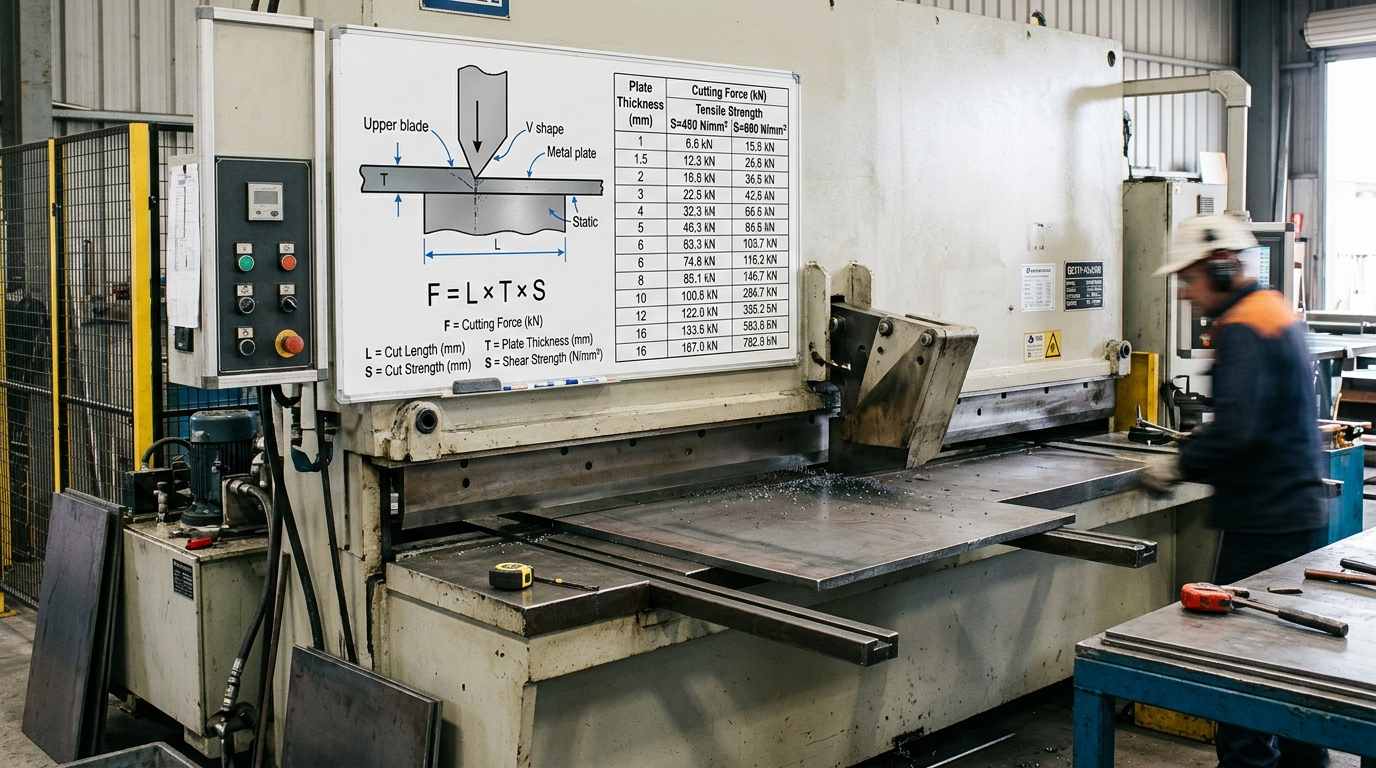
Cutting force is the load the shear must apply to part the material, and it sets the limit on what your machine and blade can actually cut. The formula is simple: F = L × t × τ — cut length × thickness × shear strength. Cutting a 10 mm × 1,000 mm mild-steel plate takes about 3,500 kN (357 tonnes-force); the same plate in 304 stainless needs roughly 1.3× more. This 2026 engineering guide gives the formula, force tables for every common thickness, material multipliers, and the penalty a dull or mis-set blade adds. Calculate the force, multiply by 1.3–1.5 as a safety factor, and size both the machine and the blade grade to that number — not to the thickest plate you hope to cut. GOOD-KNIFE matches blade grade, angle, and body section to the calculated load so the edge survives the force it actually sees.
Key Takeaways
- Formula: F = L × t × τ — cut length (mm) × thickness (mm) × shear strength (MPa) gives force in newtons.
- Mild steel baseline: about 350 MPa shear strength → 350 kN per metre of cut for every 1 mm of thickness.
- Material multiplier: aluminium 0.25×, copper 0.55×, stainless 1.3×, AR / Hardox up to 2× the mild-steel force.
- Dull edge costs force: an edge radius of 0.2 mm adds 20–40%; a rolled edge past 0.3 mm can double it.
- Size the machine and blade at 1.3–1.5× the calculated force — never at the bare number.
What Determines the Cutting Force?
Four variables set the load, and only one of them is the blade:
- Cut length (L): force scales linearly — a 2 m cut needs exactly twice the force of a 1 m cut.
- Thickness (t): also linear, but the real penalty is worse — thicker stock also needs a stronger edge.
- Shear strength (τ): the material's resistance, typically 300–380 MPa for mild steel.
- Blade condition: edge radius, clearance and rake angle change the force by 10–100% on top of the calculation.
A rake (shear) angle on the blade changes the picture: because the blade contacts the stock progressively rather than all at once, a rake of 2–4° can cut peak force by 20–35% — at the cost of more side thrust and a slightly skewed cut.
What Is the Shear Force Formula?
The standard shearing equation, used for press and shear sizing worldwide:
F (N) = L (mm) × t (mm) × τ (MPa) → F (kN) = L × t × τ ÷ 1,000 → tonnes-force = kN ÷ 9.81
Worked example — 10 mm × 2,000 mm mild-steel plate: F = 2,000 × 10 × 350 = 7,000,000 N = 7,000 kN ≈ 713 tonnes-force. Apply the 1.3–1.5 safety factor and the machine must be rated for roughly 930–1,070 tonnes to cut that plate repeatedly. A shear rated at 700 t will stall or, worse, load the blade past what the edge can carry.
How Much Force Does Each Plate Thickness Need?
Force for mild steel at τ = 350 MPa. The last column helps size mobile and alligator shears, where the cut is short rather than a full metre:
| Plate thickness | Force per metre of cut | Tonnes-force per metre | Force per 100 mm of cut |
|---|---|---|---|
| 3 mm | 1,050 kN | 107 t | 105 kN |
| 6 mm | 2,100 kN | 214 t | 210 kN |
| 10 mm | 3,500 kN | 357 t | 350 kN |
| 16 mm | 5,600 kN | 571 t | 560 kN |
| 20 mm | 7,000 kN | 713 t | 700 kN |
| 25 mm | 8,750 kN | 892 t | 875 kN |
| 40 mm | 14,000 kN | 1,427 t | 1,400 kN |
Does the Material Change the Force?
Shear strength (τ) is the material variable, and it varies by a factor of eight across common scrap. Use the multiplier against the mild-steel tables above:
| Material | Shear strength τ (MPa) | Multiplier vs mild steel |
|---|---|---|
| Aluminium (1100 / 3003) | 70–110 | 0.25× |
| Copper | 180–220 | 0.55× |
| Brass | 250–300 | 0.8× |
| Mild / low-carbon steel | 300–380 | 1.0× (baseline) |
| Stainless 304 / 316 | 400–520 | 1.3× |
| AR / Hardox / high-strength | 600–900 | 2.0× |
Light-gauge feeds sit at the bottom of that range, which is why a baler shear blade can run a keen 25–35° edge on wire and light bale without shock loading — the forces involved are a fraction of a plate mill's.
How Much Extra Force Does a Dull or Mis-Set Blade Add?
The formula assumes a sharp edge at correct clearance. In the field, these are the real penalties — and they are why a blade that "still cuts" can quietly overload a shear:
| Blade / setup condition | Force increase |
|---|---|
| Sharp edge (radius ≤0.05 mm), gap 5–10% | Baseline (1.0×) |
| Working edge (radius 0.05–0.1 mm) | +10–20% |
| Dull edge (radius 0.2 mm) | +20–40% |
| Rolled / badly worn edge (>0.3 mm) | +50–100% |
| Gap too wide (>10% of thickness) | +10–25% |
| Gap too tight (<5% of thickness) | +15–30% |
| No lubrication / galling | +10–20% |
How Do You Size a Shear and Choose the Blade?
Calculate the force, apply a 1.3–1.5 safety factor, then check it against the machine rating. If the required force is within 80% of the rating, you are already in the danger zone — either reduce thickness, shorten the cut, or move to a bigger machine. Then select the blade to the load: high-force work (thick plate, AR steel, rebar) wants a tougher grade such as M2 or H13 at 60–62 HRC with a 40–55° edge and a heavier body section; low-force light-gauge work can run a keener 25–35° edge for a cleaner cut. That is exactly why a dismantling shear blade is ground and heat-treated differently from a baler blade — the force per cut is an order of magnitude apart.
The same load logic applies beyond shearing. Compaction and forming tooling is sized the same way — briquetting dies and punches are rated to press tonnage, and running a die above its rated load causes the same premature failure a blade sees on an undersized shear.
FAQ
How do you calculate shear cutting force?
Use F = L × t × τ: cut length in mm × thickness in mm × shear strength in MPa gives newtons. Divide by 1,000 for kN and by 9.81 for tonnes-force. For mild steel, use τ ≈ 350 MPa; a 10 mm × 1 m cut then needs about 3,500 kN (357 t).
How much force does it take to shear 10 mm steel?
About 3,500 kN per metre of cut — roughly 357 tonnes-force — for mild steel. Double the length to 2 m and it becomes 7,000 kN (713 t). In 304 stainless, multiply by about 1.3; in AR or Hardox plate, by about 2.
Does a dull blade really increase cutting force?
Yes, and sharply. An edge radius of 0.2 mm adds 20–40% to the required force; a rolled edge past 0.3 mm can double it. That is why regrinding at 0.05–0.1 mm radius protects the machine as well as the cut quality.
What safety factor should you use on a shear?
Multiply the calculated force by 1.3–1.5 before comparing it to the machine rating. If the job needs more than 80% of the rated capacity, treat it as an overload risk — reduce thickness, shorten the cut, or move to a larger shear.
Does cutting force change the blade spec?
Directly. High-force cutting needs a tougher grade (M2 / H13 at 60–62 HRC), a blunter 40–55° edge and a heavier body to resist deflection. Low-force light-gauge work can use a keener 25–35° edge for a cleaner cut and lower power draw.
Every shear, blade and die is ultimately sized by one number — the force it has to deliver. Calculate it with F = L × t × τ, add the 1.3–1.5 safety factor, and spec the blade grade and angle to that load. Send GOOD-KNIFE your thickest stock, cut length and material, and we will confirm the required force and the GOOD-KNIFE blade built to carry it.