Rubber compounds play an indispensable role in modern automotive architectures, serving as mission-critical barriers for fluid containment, environmental sealing, acoustic dampening, and vibration isolation. From under-hood coolant lines and powertrain mounts to body weatherstripping and high-voltage battery enclosures, formulation choices directly govern vehicle durability, driver comfort, and regulatory compliance. A sub-optimal compound operating within severe automotive duty cycles risks premature hardening, cracking, chemical extraction, or compression failure—leading to costly warranty claims and potential field recalls.
For automotive design engineers and rubber compounders, material development presents an ongoing engineering compromise. Formulators must consistently meet stringent physical performance specifications while controlling raw material costs, maintaining batch-to-batch processability, and complying with ever-stricter global environmental directives.
This comprehensive technical guide details the end-to-end compound development lifecycle—from base polymer selection and filler-plasticizer interactions to cure kinetics, finite element simulation, and production scalability.
Key Takeaways
- Targeted Elastomer Base: Base polymer selection dictates baseline chemical compatibility, thermal thresholds, and operational limits across automotive fluid interfaces.
- Filler-Polymer Mechanics: Reinforcing fillers (carbon black vs. precipitated silica) establish the trade-off between tear resistance, dynamic modulus, and hysteretic heat build-up.
- Plasticizer Stability: Compatible process oils enhance mold flow and low-temperature flexibility but must comply with OEM fogging, odor, and low-volatility standards.
- Network Crosslinking: Peroxide cure systems deliver superior high-temperature compression set resistance, whereas sulfur packages provide superior dynamic fatigue life.
- Digital Validation: Integrating cure kinetics modeling with non-linear FEA cuts prototype mold iterations, accelerating time-to-market while reducing pre-production tooling risks.
1. Base Elastomer Selection: Application-Driven Criteria
Compound development begins by qualifying the base polymer backbone against operational environments, fluid exposure, and OEM engineering specifications (such as SAE J200, ASTM D2000, VDA 675, and GMW3232).
EPDM (Ethylene Propylene Diene Monomer)
EPDM serves as the workhorse elastomer for exterior weatherstripping, window seals, HVAC ducting, and radiator coolant hoses. Its fully saturated hydrocarbon backbone imparts exceptional resistance to ozone, UV radiation, thermal oxidation, and weathering. In accelerated aging tests, properly formulated EPDM weatherseals exceed 500 hours of ozone exposure without micro-fissuring. EPDM maintains high flexibility across -40°C to +150°C. However, its non-polar structure renders it vulnerable to swelling in petroleum-based oils, fuels, and hydrocarbon greases.
NBR & HNBR (Nitrile & Hydrogenated Nitrile)
Nitrile butadiene rubber provides outstanding resistance to mineral oils, hydraulic fluids, and fuels due to its polar acrylonitrile (ACN) content. Balancing ACN content (typically 18% to 50%) allows formulators to balance fuel swell resistance against low-temperature glass transition (Tg). For severe duty cycles involving dynamic powertrain sealing, timing belts, and aggressive fuel systems, hydrogenated nitrile (HNBR) removes backbone unsaturation, raising continuous operating thresholds to 150°C while boosting abrasion resistance.
FKM (Fluorocarbon Elastomers)
FKM compounds are specified for extreme environments, including crankshaft seals, fuel injector O-rings, and turbocharger interfaces where temperatures exceed 200°C alongside exposure to synthetic lubricants, acidic blow-by gases, and aggressive bio-fuels.
Silicone (VMQ) and Fluorosilicone (FVMQ)
Silicones excel in thermal extremes (-60°C to +200°C) with minimal compression set, making them ideal for automotive lighting gaskets, electronic potting, and turbocharger couplers. Fluorosilicones add solvent resistance for specialized fuel and vapor management applications.
2. Reinforcing Fillers: Balancing Reinforcement and Hysteresis
Fillers represent a substantial volume fraction of any technical rubber compound, directly dictating hardness, tensile strength, tear resistance, and dynamic stiffness.
|
Performance Property |
High-Structure Carbon Black (e.g., N330/N550) |
Silane-Coupled Precipitated Silica |
|---|---|---|
|
Initial Storage Modulus |
Higher |
Moderate |
|
Payne Effect (Strain Sensitivity) |
Pronounced |
Significantly Lower |
|
Hysteresis & Heat Build-Up (ASTM D623) |
~2x Higher |
Low / Optimized |
|
Wet Grip / Dynamic Traction |
Moderate |
Superior |
|
Static Dissipation & Conductivity |
Inherently Conductive |
Non-Conductive (Insulative) |
- Carbon Black Optimization: High-structure reinforcing carbon blacks (25 to 80 phr) provide high green strength and ultimate tensile performance. However, intense filler-filler networks increase the Payne effect, generating hysteretic heat under dynamic load cycles.
- Precipitated Silica Systems: Incorporating precipitated silica paired with bifunctional organosilane coupling agents promotes strong chemical bonding between hydrophilic silica and hydrophobic polymers. This configuration yields low hysteresis and reduced heat build-up under cyclic deformation.
- Synergistic Blends: For automotive suspension bushings, engine mounts, and exhaust isolators, formulators frequently design hybrid packages (40–50 phr carbon black combined with 10–20 phr treated silica) to decouple dynamic stiffness from damping losses while retaining electrical grounding capability.
3. Plasticizers and Processing Aids: Thermal Stability and Volatility
Plasticizers lower compound viscosity, facilitate filler dispersion during internal mixing, lower glass transition temperatures, and improve extrusion flow. In automotive applications, plasticizer selection is constrained by long-term durability and passenger cabin safety standards:
- Polymer Compatibility and Dosage: Typical loadings range from 30 to 120 phr depending on target Shore A durometer. Mismatched solubility parameters cause oil migration to the surface, resulting in chalky blooming, adhesion failure, and progressive hardening in the field.
- Volatility and Fogging Compliance (DIN 75201 / SAE J1756): Under-hood components and interior climate seals must not release condensable volatile organic compounds (VOCs) that fog windshields or emit unpleasant odors. Paraffinic oils with heavy molecular weight distributions (Group II/III hydroprocessed white oils or bright stocks) replace conventional aromatic and naphthenic oils, eliminating toxic polycyclic aromatic hydrocarbons (PAHs) while satisfying OEM fogging numbers.
4. Crosslink Architecture: Sulfur vs. Peroxide Vulcanization
The crosslink density and chemical bond structure govern whether a cured elastomer behaves elastically or suffers permanent plastic deformation under clamp load:
|
Criteria |
Sulfur Vulcanization System |
Organic Peroxide System |
|---|---|---|
|
Crosslink Bond Type |
Mono-, di-, polysulfidic (-Sx-) |
Direct C-C single bonds |
|
Bond Dissociation Energy |
~270 kJ/mol (lower thermal stability) |
~350 kJ/mol (high thermal stability) |
|
Continuous Service Temperature |
Up to 120°C |
Up to 150°C - 175°C |
|
Compression Set (Long-term load) |
Moderate / High (creep susceptible) |
Exceptionally Low (<20%) |
|
Thermal Reversion Resistance |
Prone to reversion at high cure temperatures |
Reversion-free |
|
Tensile & Fatigue Endurance |
Superior dynamic flex life |
Moderate; enhanced via co-agents |
Sulfur vulcanization creates flexible polysulfidic bridges that allow local stress redistribution around micro-defects, making sulfur packages the premier choice for parts subject to continuous dynamic flexure such as suspension dust boots and drive-shaft bellows.
Peroxide crosslinking forms direct carbon-carbon bonds requiring substantially more thermal energy to dissociate. For static engine cooling gaskets, HVAC seals, and turbo hoses subjected to extended clamp retention tests, peroxide cure systems eliminate reversion degradation and deliver minimal compression set. Incorporating polyfunctional co-agents (e.g., TAC, TAIC, or TMPTM) elevates crosslink efficiency and increases modulus.
5. Compounding for Next-Generation Electric Vehicles (EVs)
Electrification transforms performance expectations for traditional automotive rubber components:
- Acoustic NVH Optimization: Without internal combustion engine noise, high-frequency cabin noise from road friction and electric motors becomes noticeable. Precision rubber dampers require tailored loss factors (tan delta) across distinct operating frequencies (100 Hz to 1 kHz) to attenuate structural cabin vibration.
- Battery Pack Sealing (UL 94 V-0 & IP67/IP6K9K): Enclosure gaskets for EV battery trays must combine low closure force with robust water and dust sealing throughout vehicle lifecycles. Formulations incorporate eco-friendly non-halogenated flame retardants to pass UL 94 V-0 flammability tests while preventing flame propagation in thermal runaway events.
- Dielectric Insulation & Coolant Resistance: Battery immersion cooling and multi-circuit coolant loops demand elastomers that maintain high dielectric breakdown strength (>20 kV/mm) while resisting chemical breakdown against specialized glycol-water and synthetic dielectric fluids.
6. Environmental Compliance & Material Circularity
Modern automotive formulation demands continuous chemical substance screening from the initial recipe phase:
- Global Directives (REACH & RoHS): Automotive compounders must monitor candidate substances under the EU REACH SVHC register. Target concentrations of restricted substances must remain strictly below 0.1% w/w. Phthalate plasticizers (DEHP, DBP, BBP) and Annex XVII restricted PAHs in process oils are strictly prohibited.
- Decarbonization and Circular Formulations: OEMs are setting aggressive Scope 3 decarbonization targets. Modern recipes increasingly replace fossil-based carbon black with recovered carbon black (rCB) derived from end-of-life tire pyrolysis (10% to 25% substitution without mechanical loss), bio-based plasticizers derived from vegetable feedstock, and ultra-fine micronized devulcanized rubber powders.
7. Virtual Simulation and Prototyping Validation
Automotive Rubber Compound Formulation, Kinetics Modeling, and Physical Testing Workflow
Digital engineering workflows now replace costly trial-and-error physical iterations during compound development:
- Cure Kinetics Modeling: Moving Die Rheometer (MDR) data feeds Arrhenius reaction equations to predict scorch safety (ts2) and optimum cure time (t90). Coupled with transient thermal conduction software, engineers ensure thick-walled rubber parts cure evenly throughout the cross-section without over-curing outer surfaces.
- Non-Linear Finite Element Analysis (FEA): Hyperelastic material models (Mooney-Rivlin, Ogden, Yeoh) derived from uniaxial tension, planar shear, and biaxial compression testing predict stress relaxation, sealing pressure retention, and structural fatigue life before tooling is cut.
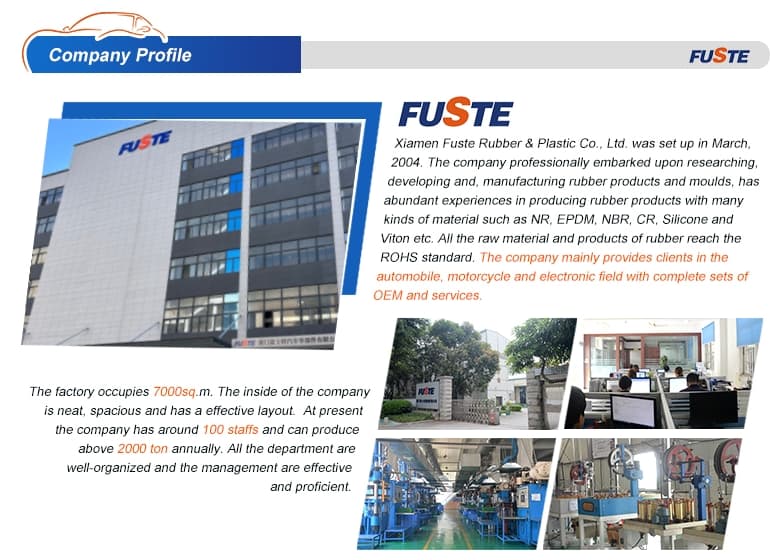
8. Value Engineering & Manufacturing Integration with Fuste Rubber
A chemically optimized formulation requires disciplined industrial compounding and precise tool engineering to deliver reliable parts in high-volume production. Fuste Rubber bridges formulation chemistry with scalable automotive manufacturing:
- Turnkey Engineering: Providing seamless integration across custom compound design, in-house mixing, precision CNC tooling, transfer/injection molding, and cryogenic deflashing.
- Certified Quality Infrastructure: Operating under stringent IATF 16949:2016 quality systems, equipped with fully automated continuous mixing lines, rotorless rheometers, ozone environmental chambers, and computerized optical measurement systems.
- Material Testing Compliance: In-house laboratory validation ensures all compounds meet OEM standards under ASTM D2000, SAE J200, DIN, and JIS specifications.
- Diverse Automotive Product Portfolio: Supplying tier-one automotive manufacturers globally with custom EPDM, NBR, HNBR, FKM, and Silicone solutions, including wiring harness grommets, cooling system gaskets, air intake bellows, and NVH chassis components.
Accelerate Your Development Cycle: Whether you require custom formulation development to meet tight OEM specifications or need to re-engineer an existing component for lower cost and superior life, contact the Fuste Rubber engineering team today to review your technical drawings and compound specifications.
Frequently Asked Questions (FAQ)
How do engineers prevent compression set failure in automotive coolant seals?
Preventing compression set requires specifying a peroxide-cured EPDM or HNBR polymer system with optimized crosslink density, avoiding high sulfur loadings that degrade above 100°C. Utilizing high-purity paraffinic oils with minimal volatility and maintaining filler loading below 60 phr preserves matrix elasticity under continuous bolted clamp loads.
What causes rubber bloom on molded parts, and how is it corrected?
Blooming occurs when compounding additives (such as insoluble sulfur, primary amine accelerators, or incompatible plasticizing oils) exceed their thermodynamic solubility limit within the cured polymer matrix, migrating to crystallize on the surface. Corrective actions involve balancing accelerator packages, switching to high-solubility plasticizers, or employing secondary retarders to optimize reaction kinetics.
Can simulation software accurately predict mold shrinkage in custom rubber profiles?
Yes. Thermal expansion coefficients differ significantly between polymer matrices and steel tooling (rubber shrinks roughly 1.5% to 3.5% upon cooling). By integrating cure kinetics, filler loading ratios, and thermal contraction models into virtual CAE packages, tooling engineers can predict differential shrinkage accurately, preventing costly tool rework.
How does Fuste ensure compliance with strict OEM fogging and odor specifications?
Fuste employs ultra-low volatility, severely hydrotreated paraffinic process oils, and optimized peroxide cure packages that leave minimal volatile reaction byproducts. All materials intended for cabin and under-hood applications undergo rigorous gas chromatography and gravimetric fogging testing in accordance with DIN 75201 standards prior to production release.