In precision manufacturing sectors such as semiconductors, liquid crystal displays, photovoltaics and microelectronics, extremely stringent cleanliness standards are required throughout production processes. Featuring ultra-low residue, ultra-low particle generation and ultra-low ion emission, BSL (Baoshili) Cleanroom Wipers have been widely adopted and applied in the above industries.
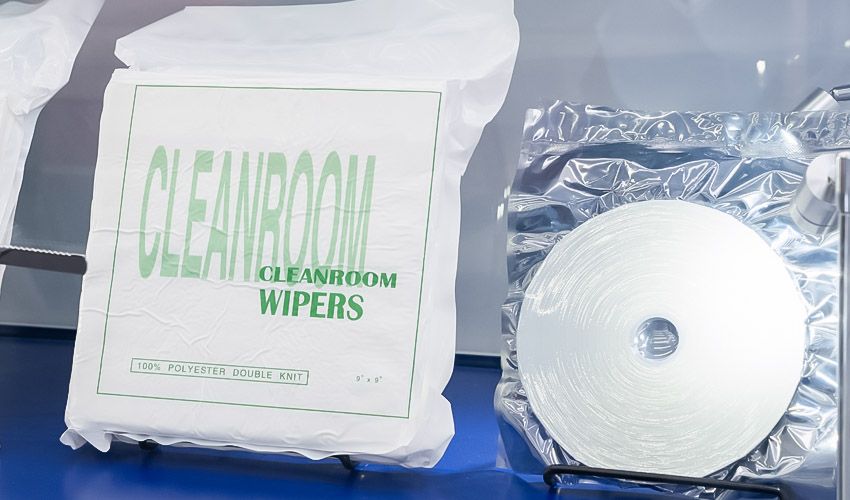
The recognition from customers stems from BSL’s rigorous professional quality control. Taking BSL microfiber Cleanroom Wipers as the research object, this article breaks down the key testing items of Cleanroom Wipers in detail.
01. Abrasion Resistance Test
Abrasion resistance is generally categorized as a physical property test of fabrics. Nevertheless, in the Cleanroom Wiper industry, abrasion will directly generate particulate matter, so this indicator shall be incorporated into the scope of cleanliness control. With advanced continuous weaving and ultrasonic edge sealing processes, BSL microfiber Cleanroom Wipers achieve nearly zero particle shedding, effectively preventing secondary contamination during wiping.
02. Liquid Absorption Capacity and Absorption Rate
The liquid absorption test is implemented in accordance with Section 8 of IEST-RP-CC004.3, focusing on evaluating the absorption performance of Cleanroom Wipers.
- Liquid absorption capacity: Approximately 450 milliliters per square meter, with excellent liquid storage capacity.
- Liquid absorption rate: Deionized water climbs 1 centimeter via capillary action within 3 seconds, which enables rapid liquid adsorption and reduces liquid residue after wiping.
-
03. Ion Content Test
Cleanroom Wipers are often in contact with sensitive materials such as electronic components and semiconductor chips during cleaning. Harmful impurity ions including chloride ions (Cl⁻) and sodium ions (Na⁺) inside the wiper may transfer to product surfaces, resulting in circuit short circuits, material corrosion and equipment performance degradation.
Therefore, Cleanroom Wipers must be tested for inorganic anions and cations as specified in Section 7.2 of IEST-RP-CC004.3. Professional testing verifies that BSL Cleanroom Wipers maintain stable ion content, which effectively avoids ionic contamination.
04. NVR Test
Cleanroom Wipers are commonly used in high-cleanliness demanding fields including electronics, semiconductors, optics and medical treatment. The NVR test is designed to detect non-volatile residues precipitated from Cleanroom Wipers, such as grease, silicone oil, plasticizers and inorganic salts. These residual substances may remain on working surfaces after wiping and undermine product performance and yield.
All BSL Cleanroom Wiper products are tested in compliance with Section 7.1 of IEST-RP-CC004.3. At present, BSL Cleanroom Wipers deliver outstanding test results in deionized water, isopropyl alcohol and other test solutions, and can thoroughly prevent non-volatile residue contamination.
05. LPC Test
The LPC test simulates wet application scenarios to quantify the number of particles released by wiping cloths, so as to assess the contamination risk to high-precision instruments, optical surfaces and other delicate products. As a core link in the quality control of Cleanroom Wipers, LPC testing safeguards production safety and product quality in high-grade clean environments.
In accordance with the requirements of Section 5.1 and 5.2 of IEST-RP-CC004.3, all LPC indicators of BSL Cleanroom Wipers fully meet industry standards.
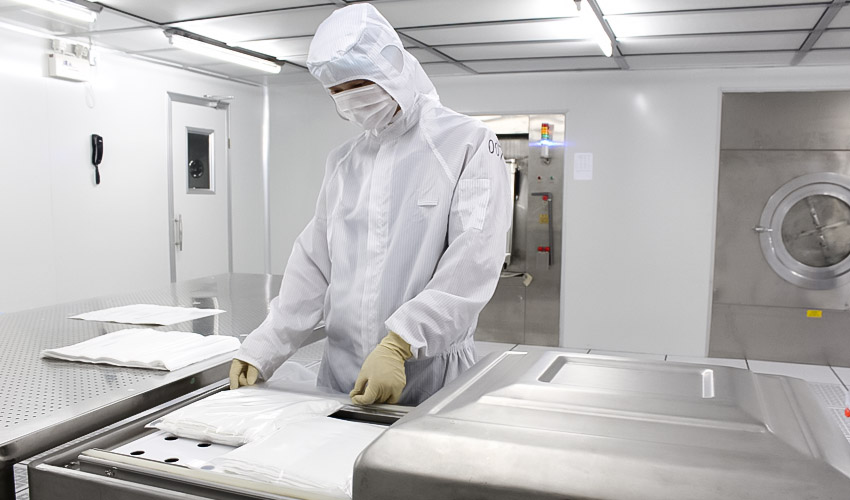
To guarantee consistent and stable product performance, BSL has established a Class 100 laboratory, equipped with professional testing equipment including infrared spectrometers, ion chromatographs, liquid particle counters, energy dispersive X-ray fluorescence spectrometers, Hamiltons tumble testers and microscopes. It ensures that every batch of products steadily reaches the standard in core indicators such as LPC, NVR and ion content. With a complete portfolio of specifications, our Cleanroom Wipers are dedicated to meeting the usage demands of Class 10, Class 100, Class 1000 cleanrooms and other differentiated application scenarios.